To Lead Forth

July 1, 2025

My research on Transformative Information Encountering has resulted in a joyous journey back to my academic roots in Philosophy, my undergraduate major. I had been reading L.A. Paul’s book, Transformative Experience, which gifted me a beautiful approach to describing the difference between the ongoing development customary to any human as they mature, as opposed to the less frequent major transformations, what Paul calls personal transformation. I leaned on her description of this distinction in the article I am currently writing. This one will share the results of my interview study.

I intended to continue reading her book today, but as I settled into my office chair with a warm mug of tea, I discovered that I had left the book and my reading notebook at home. Not wanting to waste a rare opportunity for hours of uninterrupted reading, I turned to my bookshelf and opened the book I had been planning to read after Paul’s: Becoming Someone New, a collection of essays on transformation, edited by Enoch Lambert and John Schwenkler. This morning I read and contemplated the introduction, which describes the current landscape of thought about transformation. This means I have yet to dig deeply into the ideas that will be presented in each chapter, but even the introduction had me scribbling notes and questions, which I will present in the following paragraphs with full knowledge that further reading will further illuminate these preliminary reactions. I reserve the right to disagree with myself as I learn more.

In discussing L.A. Paul and Edna Ullman-Margalit, Lambert and Schwenkler present the idea that transformation is incongruous with a rational tendency towards self-preservation, in that to transform is to obliterate an old self in favor of a new self (Ullman-Margalit’s terminology). It is not rational to choose to obliterate oneself. This makes sense to me on face value, and also reminded me of a further reason opportunities for transformation are often rejected. Psychologists Sloman and Fernbach, in their book The Knowledge Illusion, describe how humans have an instinct to fear and avoid changing their beliefs and values, because beliefs and values are shared with a community. Humans rely on communities for survival, therefore turning away from the beliefs and values shared with our communities has the potential to separate us from our means of survival. This adds to the idea that choosing transformation is not obviously rational.

But then I remembered a book I read nearly two decades ago called Walking on Water, by Derrick Jensen. In discussing what education should be, Jensen explores the root word of educate, educe:

Here’s something I wish I would have told my students. The word education . . . comes from the latin root e-ducere, meaning “to lead forth” or “to draw out.” Originally it was a midwife’s term meaning “to be present at the birth of.” I would contrast that with the root of the word seduce, which is closely related, but with a striking difference. To educe is to lead forth; to seduce is to lead astray . . . I wish I had suggested that our departments of education be called, if we were honest, departments of seduction, for that is what they do: lead us away from ourselves.

Derrick Jensen, 2003, Walking on Water, Chelsea Green Publishing Company, p. 15

Merriam Webster defines educe as bringing out something latent, i.e. potential. As Jensen characterized seduction as leading someone away from themselves, then maybe education is leading someone towards themselves. As a former teacher, I connect with the goal of education as leading students to be their most actualized selves. I do not think I ever mastered teaching in this way, but this idea defined the kind of teacher I aspired to be.

If humans are indeed on a journey of becoming more themselves, then perhaps experiences of personal transformation are not as much a destruction of the old self as moments of accelerated progress towards increased selfness.

I think I agree with Paul that there is opacity as far as who we will be and what we will value on the other side of a transformation, such that we may not be able to rationally choose to transform with our conscious minds, but there is also much written in neuroscience about how the unconscious mind drives our behaviors and decisions (see Leonard Mlodinow’s Subliminal). So a question I have in mind is whether our unconscious mind can make a rational choice for us to become more ourselves. Can we sense when the opportunity to engage with an experience of personal transformation will lead us into a more authentic existence? Given how instinctual the unconscious mind is, can any rational thought be ascribed to it? Then again, what is more rational than, “That’s a tiger. Run!” (Must “ration” and “reason” be conceptually separate? Is instinct not an accelerated process of reasoning?)

In 2007 I accepted a two-year contract teaching at an international school in Addis Ababa, the capital city of Ethiopia. I knew the experience would change me, and though I did not know exactly how, I knew what I hoped to get out of it. In teacher-training school, we had spent a lot of time talking about how the teacher becomes the dominant culture in a classroom, and for students who share their culture with their teacher, that can be an affirming experience. Then again, for students who don’t share their culture with their teacher, it can be extremely alienating, to the point of being a barrier to learning, unless the teacher takes steps to mitigate the harm. In reflecting on these lessons, I came to the conclusion that I had never really experienced being in a setting long-term where the culture I grew up in was not the dominant one. Of course, given my ethnic and religious identities, I have plenty of experiences in which my identities were in the minority in a given setting, but I had never truly been in a situation where the dominant culture was entirely foreign to me. I felt like I would not be able to empathize with the full diversity of my potential future students without this firsthand experience, so I sought it out deliberately. (Yes. I also wanted to travel and had limited funds.)

As I approached my date of departure for Addis, my friends would ask me how I was feeling, and all I could think was, “It feels like I am about to die, and I have no idea what the afterlife will be like.” Comparing it to death was not to say I was dreading it or regretting my choice to go, but simply that I could not picture life on the other side and was very aware that life as I knew it was about to end, because even if I returned home after the experience, I would be returning as a person wholly changed by the experience. I had read the guidebooks, watched videos, studied the language, eaten the food, talked to people who had been there, but none of this could actually tell me what I would be like and feel like once I was living full time in this new country.

I had a similar experience becoming pregnant and giving birth, which is an experience of personal transformation Paul discusses explicitly. Bringing a new life into the world is maybe a strange thing to compare to death, but I remember having the same thought as I had before moving to Addis: life as I knew it was about to end.

If transformation is like death, I am also reminded that in my circle of family and friends we often refer to death as a transition. This is a conceptualization of death not as an ending, but as a changed of the state of existence. Leaning on this leads me to question Ullman-Margalit’s conceptualization of old self vs. new self, and long for a better understanding of a continuity of self, a self that with each transformation/death/transition becomes more of itself rather than a wholly different self.

Wrapped up in this are questions I have about truth. In choosing (or rejecting) opportunities to transform, are we choosing whether to take a leap into a truer self? Are our unconscious minds aware of such a choice even when our conscious minds are not? And if this is a decision-making process that is driven by our unconscious, is it something we share with other living creatures, or is a sense of truth—or a drive for self-actualization—uniquely human?


Efference

May 8, 2025

I never put much effort into keeping up with this blog after I was successful in securing my present position as University Archivist at San José State. Afterall, I started this site so that when prospective employers Googled me they could find all the information I wanted them to have access to in one shiny package. I’ve kept the domain just in case I needed it for something in the future, but have done little with it beyond occasionally uploading an updated CV.

Now as I embark on a new phase of my research on Transformative Information Encountering (TIE), maybe it is an opportunity to turn over a new leaf with this blog as a place to digest ideas from my research as they arise, and before they are ready to be woven into a scholarly publication. We shall see if I make it past this one post. Does anyone even read blogs anymore?

Maybe my mother. (Hi, mom!)

Last night I stole a few minutes before baby-bedtime to read a section of Louise M. Rosenblatt’s Making Meaning With Texts, which I am grateful to Dr. Scott Jarvie, SJSU professor of English Education for recommending when I was picking his brain about Reader Response Theory. Specifically, I read Part 2, Section 6, “The Literary Transaction: Evocation and Response,” and was quickly transported into my internal contemplation zone by Rosenblatt’s discussion of efferent versus aesthetic reading.

To summarize, Rosenblatt describes all reading as taking place on a continuum between efferent (reading for information) to aesthetic (reading for enjoyment), and which end of the continuum the reading leans towards is not always determined by the literary genre (73). That is, a reader might read non-fiction aesthetically, or have an aesthetic experience while reading it (as I have during some of my most-cherished experiences with my favorite non-fiction books). Likewise, a reader might read fiction or poetry efferently, seeking the information contained in it rather than the enjoyment of reading it. By describing it as a continuum, Rosenblatt does not suggest that this is a dichotomy, but rather two types of reading that can be more or less present in a reading experience (74).

A bi-directional arrow with the left side labeled "Efferent" and the right side labeled "Aesthetic"

Along this continuum a reader could theoretically be reading purely efferently or purely aesthetically, or exactly at the midpoint between the two, but most reading likely happens somewhere in the in-between places.

I used to love a good two-ended continuum, but then I was introduced to another way of conceptualizing a continuum thanks to the Genderbread Person at itspronouncedmetrosexual.com. The problem with the above conceptualization of a continuum is that it implies that the more aesthetically I am reading, the less efferently, and vice versa. But it can also be conceptualized such that I can dial up my levels of efference or aesthetics independently of one another:

Two stacked arrows pointing right, with the top arrow labeled "Efferent" and the bottom arrow labeled "Aesthetic"

I prefer to think of these two types of reading on their own independent continuums. It better accounts for my experiences of reading books like Undrowned by Alexis Pauline Gumbs, which is simultaneously marine biology and prose poem.

I have not yet read enough Rosenblatt to know what she would think about these two conceptualizations of her reading continuum.

Rosenblatt’s discussion of efferent versus aesthetic reading and what it means for teachers of reading is highly engaging but is not what got my wheels turning as my current pressing research question is what are the mechanisms at play when someone reads a book (or hears a song, or sees a movie, or hears a speech, or otherwise encounters an information resource) and changes their world view or deeply held beliefs. 

Working with data from my recent qualitative interview study, I discovered that when I asked my participants to describe resources that had an impact on their thinking about the world, they tended to emphasize personal narrative and works of art. But when I asked my participants to walk me through their transformative experiences, the resources they identified were largely analytical, scholarly, or journalistic in nature. This has implications for the types of resources information professionals (i.e. librarians and archivists) collect and highlight when engaging with our communities.

Adding this layer from Rosenblatt has me wondering if my interview participants can recall whether they were approaching these transformative resources with more or less efferent and/or aesthetic mindsets, and whether I can find any correlation between how they approached a resource and the impact it had on them.

There is much in the LIS Information Encountering literature on the importance of a prepared mind to whether a serendipitous encounter with information will have an impact. I am wondering if it’s possible to discover whether an efferent or aesthetically-attuned mind is more or less open to serendipity and transformation.

I hope to have the opportunity to explore this in my upcoming oral history project and am looking forward to contemplating and sharing what I may uncover.

Inclusive Processing of Indigenous Collections at SAA/COSA 2019

I wrote this post for the Human Rights Archives section of SAA. To see this post in its original context, click here.

When it comes to processing collections representing marginalized peoples, archivists must cultivate an understanding of the power of their role without letting that awareness immobilize their work. The session “Beyond Familiar Terms – Repairing Indigenous Collections through Inclusive Processing” at the Society of American Archivists annual conference sought to address this struggle.

Presenters Anna E. Harbine and Tisa Matheson of the Northwest Museum of Arts & Culture (MAC) discussed their experiences with indigenous collections, provided an overview of the guidelines framing their work, and introduced case studies for attendees to consider and discuss in small groups. Harbine, the Johnston-Fix Curator of Archives and Special Collections, came to the MAC with no background in indigenous collections and strives to educate herself and learn from others. Matheson works with Tribal Collections at the MAC. In contrast to Harbine, she has over twenty years of experience with these materials. Matheson acts as a bridge of communication between her institution and indigenous governments affected by and represented in the museum’s collections. Together, Harbine and Matheson highlighted several key practices in working with indigenous collections.

Language: The act of describing indigenous collections in English is immediately problematic. Translating concepts from one language to another impacts the meaning and context of the original words. Additionally, due to the history of how indigenous collections have been handled in archives and museums, archivists must work to repair and counteract the impact of colonialist language and dehumanizing terminology that goes beyond simple translation issues.

Harbine and Matheson addressed “Indian”, “American Indian”, “Native American”, “First Nations”, and “Indigenous Peoples” as terms that all have the potential to offend, and all fail to adequately communicate the intended concept. They discussed the importance of interrogating nomenclature in archival catalogs, which often includes slurs such as “squaw” and “red skin,” or refers to traditional regalia as “costumes.” In addition to interrogating the catalog, it is important to discuss language with volunteers who may defer to the perceived authority of outdated captions and catalog descriptions without questioning the use of these terms. Above all, Matheson and Harbine emphasized the importance of remembering that you are trying to use a foreign language to describe another culture’s concepts and experiences. At the MAC, staff worked with local tribal governments to develop an understanding of preferred terminology.

Organizational Culture: The MAC created an American Indian Culture Committee that includes representatives from tribal governments who help oversee collections and identify needed changes in policies and procedures. Through this committee, the MAC has implemented guidelines for handling objects that acknowledge tribal preferences. These include gender role practices for certain objects and restricting public access to objects as necessary.

Collaboration: Every federally recognized tribe has its own website and culture department. This can help archivists learn about and connect with the tribes represented in our collections. It is also important to keep in mind that not every tribe will be willing to work with the archive. Engaging with indigenous communities is a time commitment, but it is important to invest that time to preserve the potential for building a collaborative relationship. Forging ahead without that relationship can create irreparable breaches in trust.

Additional ideas arising from contemplating case studies included: creating policies and procedures to change future practices, taking responsibility for any harm caused by your institution’s actions, ensuring thorough documentation for the sake of any archivist who might succeed you, and knowing when decisions should be made by someone other than the archivist.

Matheson and Harbine acknowledged that archivists commonly receive indigenous collections we do not have the time to process properly, or are asked to make decisions about indigenous collections we do not have the expertise to make. They encouraged us to ask questions while remembering that there is often more than one correct answer. It has to be acceptable to take things slowly and allow processing to wait while you search for answers.

Reflections on the Art of Correspondence

While completing inventories of donations to the San Francisco Maritime Museum, I have found myself spending a great deal of time reading correspondence written between the late 1800’s and the 1970’s. As I read letters written from ship captain’s wives to children back home, and from sisters to brothers at sea, I am struck by how often the topic of a letter is the mundane goings on of every day life. People share details about the weather, what they have eaten, and purchases they have made or hope to make.

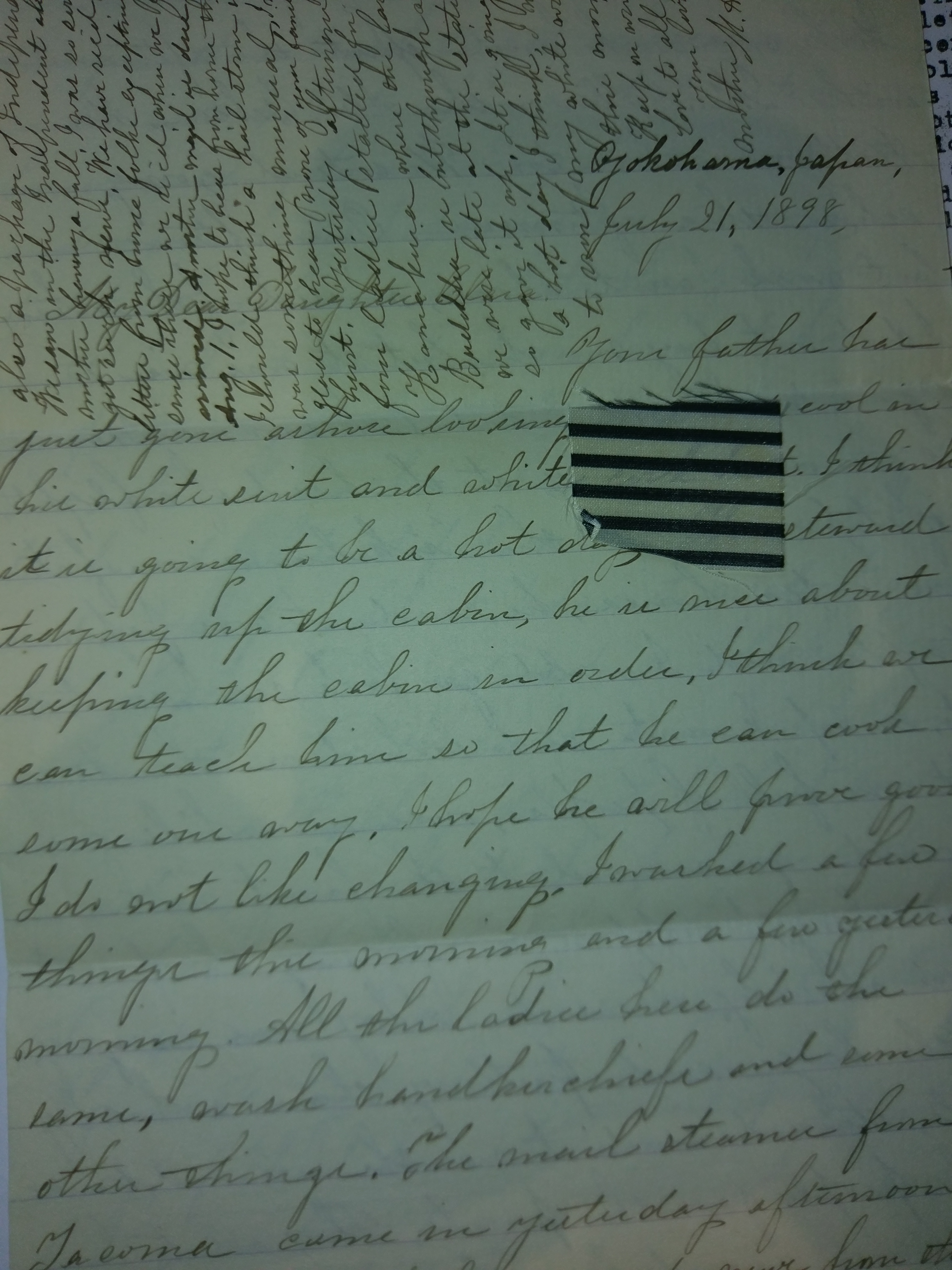
Of course, circumstances make some of these details extraordinary to my eyes in the 21st century. A ship captain’s wife, at sea with her husband, writes home about meals of dolphin chowder, and purchases of fabric in Yokohama, Japan, even including a swatch of fabric folded into the letter’s pages.

A sister writing to her brother while he is overseas with the Navy during World War II describes purchasing the family’s first television set and surprising her children with it.

I am just the right age to have experienced both pen pals and the beginning of chatrooms and email. I have seen my most regular communication with friends transfer from phone calls to text messages. If I want to have phone call with a friend, I now text them to find a good time for both of us, and our calls often happen over an internet video call service. A few years ago I bought a new cell phone and it took me several weeks to discover that the mic component was not functioning; that’s how infrequently I use a phone to have a conversation with anyone.

If I was going to sit down to write a letter today, I would feel like I needed to have something important to say — a story to tell. That is why the mundane correspondence in the archives is so interesting to me. The sea captain’s wife seemed to use her letters home much how we use text messaging or Instagram, even knowing that the messages would not be received for months. There’s a simple “here’s what I’ve been up to” quality to them. And because she saw fit to report her everyday life to her daughter back home, we now have a unique historical record of her unique reality.

Partnering Sustainability and Preservation

I recently completed a research project about sustainable preservation practices for archives. I was initially inspired by an incidental sentence in Jessica Phillips’s 2015 article for The American Archivist, “A Defense of Preservation in the age of MPLP”. In the midst of a criticism of the More Product, Less Process approach, Phillips says, “. . . as more institutions attempt to ‘go green,’ the high energy consumption of the archives’ climate control systems may well come under scrutiny” (page 478).

This made me wonder how archivists were thinking about sustainability, and what opportunities existed for making archives more environmentally friendly. I was spurred onward by a conversation on the topic with archivist Sean Heyliger at the African American Museum and Library of Oakland. He confirmed my suspicion that many archives would hesitate to alter practices due to the potential cost of doing so, and the chronic lack of funding with which too many institutions must cope. I began to wonder what the landscape of sustainable preservation practices really looks like. Is it as costly as imagined? Are there small changes archives can undertake to increase the sustainability of their practices?

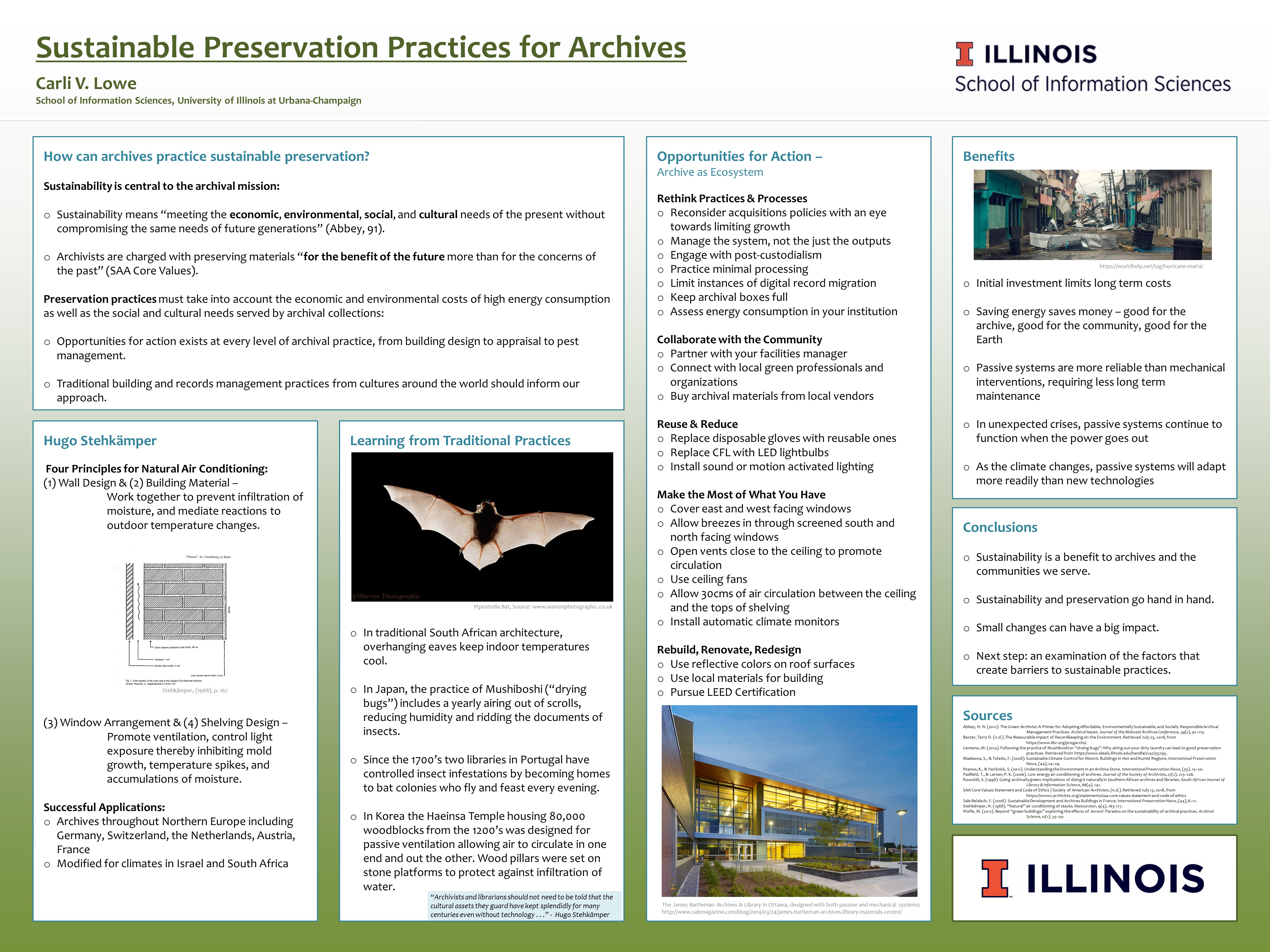
I gathered and read multiple articles on the topic, written between 1988 and 2018. From my research, I concluded that sustainable preservation practices have the potential to save money, while also providing more reliable preservation conditions for the materials in the archive’s care.

Click the image to view a pdf of the presentation poster.

Large scale opportunities exist in reconsidering building design: The initial costs of building an archive for passive climate control can be high, but in the long term a passive system requires far less maintenance.

Small scale opportunities exist across the board: Simple acts such as keeping archival boxes full and allowing for the movement of air among shelves can stabilize temperature and humidity levels with little to no mechanical intervention.

Cultural practices may provide additional guidance: Materials were preserved for centuries before the use of electricity and fossil fuels. Drawing on the wisdom of traditional preservation practices will point us in the right direction.

I am looking forward to learning more about this topic, especially understanding more about the barriers to enacting sustainable practices.

The Southern Pacific Dumbarton Bridge Records

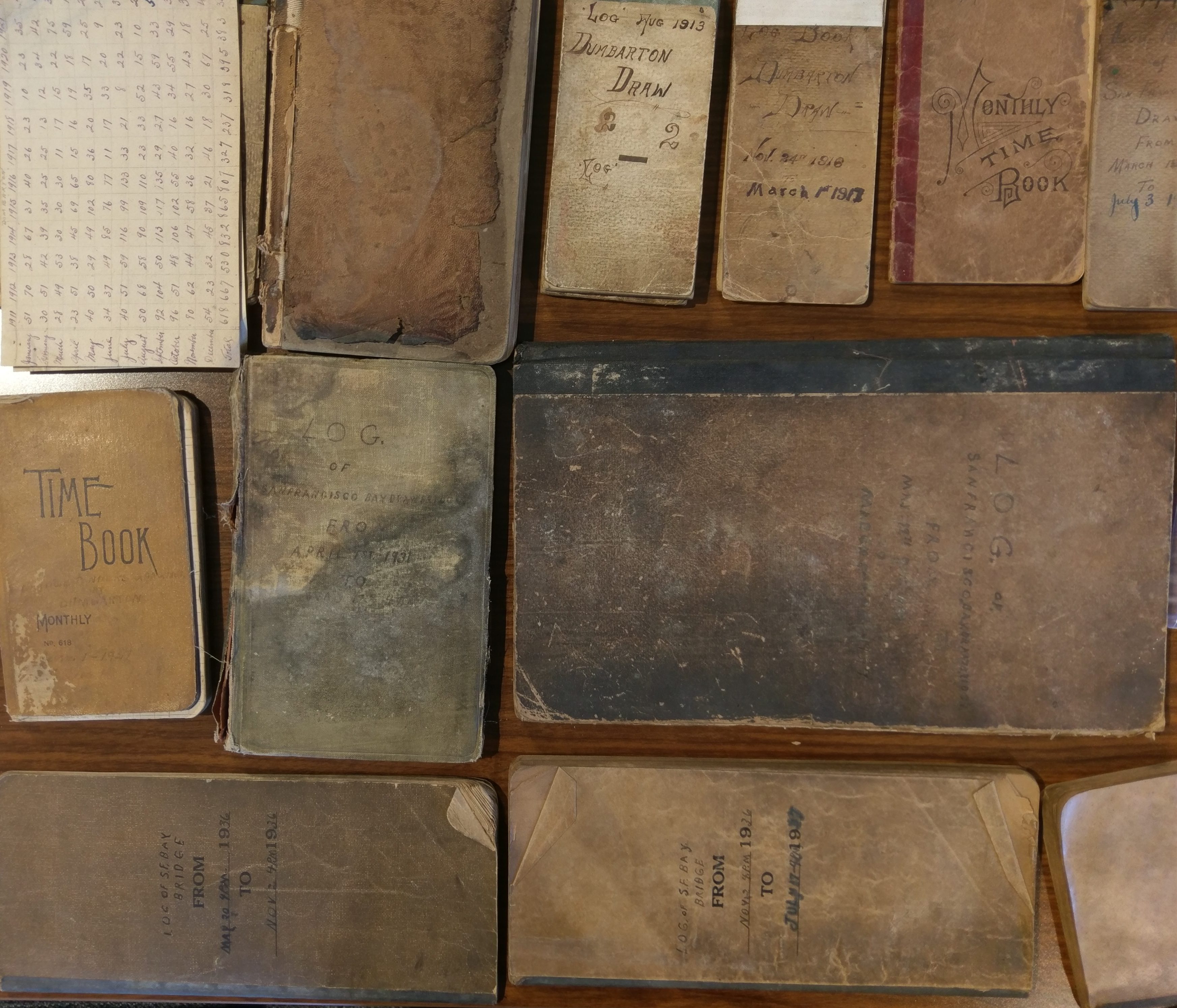
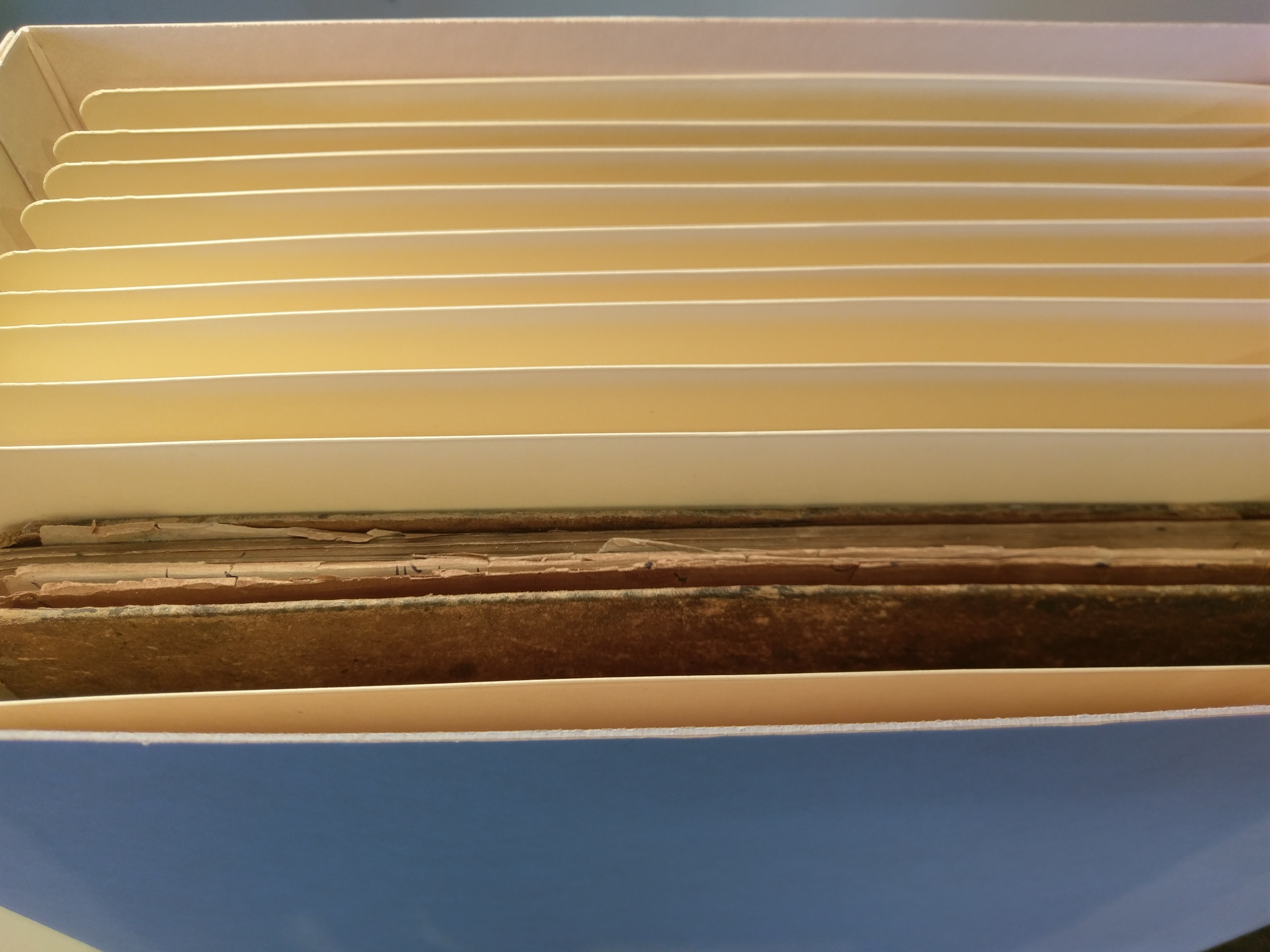
The Dumbarton Bridge Records, my latest charge at the San Francisco Maritime Museum Research Center, consist of 63 items which pack into approximately two cubic feet. The majority of these items are log books containing the handwritten notes of seven decades of bridgetenders charged with opening and closing this Southern Pacific Railroad-owned bridge to allow vessels to pass as needed.

There is a great deal of potential research value I can imagine for these logs. The data within them reveals ship names, weather conditions, tracking of tides, as well as grittier details such as mechanical failures, collisions, and at least one mention of looking out for a dead body reported to be floating on the current. A researcher could discover the names of bridgetenders, their rate of pay, the hours they worked, and even their addresses and phone numbers. One could speculate on the ethnic groups represented by the last names of the workers, and observe how these change over the years with different waves of immigration and/or shifts in nationalist sentiment. There is also great potential in asking questions about what is not present; while there are several logs missing from the timeline, it is notable that the collection contains only two logs from the 1940’s.

What is most intriguing to me, however, is all of the ways this collection might be utilized that I cannot now imagine. As I clean, log, file, label, and box these items, I experience the thrill of burying something in a time capsule, knowing that sometime in the future, whether near or distant, someone unknown to me will uncover it. I am content that I cannot now know what they will make of what they find.

An Affinity for Curling, Browning Papers

I have begun an archives technician internship at the San Francisco Maritime Museum, and I am overjoyed to be back in an archival setting. On my first day, my supervisor presented me with two bankers boxes of curling, browning papers, and I couldn’t help but note aloud my immediate excitement at seeing them, even before I had any idea of their contents or significance. My supervisor commented, “You’re in good company.” I suppose it’s not everyone who would look forward to spending several hours sifting through the financial records of 1940s shipbuilders — though even as I type that, it’s difficult for me to imagine why not!

Most of the papers were straightforward business documents, but a few curiosities stood out to my novice eyes: a slip of paper listing lunches for crewmen including twelve liters of milk, a $15 receipt for an accordion player to perform at a landing, a paragraph describing the design of a galley in minute detail, and blueprints of the materials the shipbuilders had ordered.

It never ceases to amaze me what a box of historical documents can reveal. This is why I love working in archives. Today, while performing an initial review that will allow me to write up an inventory, I had hands full of evidence of the amount of manufacturing activity that used to happen in the San Francisco Bay Area. The boxes I reviewed included purchase orders and invoices from steel mills and copper forges in the same cities where we now have tech startups. This adds another piece to the story of how the area I call home has changed over the last several generations. My supervisor also pointed out how much of the manufacturing was driven by the needs of World War II.

All of this from two boxes of curling, browning paper. It is truly a privilege to have access to history in this way. My hope is that as I learn the art and science of this profession, I will discover ways to engage more people with the mind-bending joy of learning through primary source material.

We’re All in it Together

I wrote the following as the Spectrum guest blogger for the ALA 2018 Annual Conference in New Orleans. To see this post in its original context, click here.

Who better to create an engaging presentation than engagement librarians? Each presenter in “We’re All In It Together: Focusing Outreach and Assessment to Your Institution’s Strategic Goals,” a session of the 2018 American Library Association (ALA) Annual Conference and Exhibition in New Orleans, provided concise and inspiring information about how they use strategic goals in designing outreach and assessing the impact of their programs.

Jason Kruse, undergraduate engagement librarian at Northwestern University; Amy Wainwright, outreach and student engagement librarian at John Carroll University; Kristen Mastel, outreach and instruction librarian at University of Minnesota; and John M. Jackson, head of outreach and communications at Loyola Marymount University, introduced us to their strategies with a level of enthusiasm that made it clear how dedicated they are to the work that they do. The presentations were moderated by Chris Davidson, campus and community engagement librarian at Northwestern.

One piece of advice was to consider where you already are, instead of starting from scratch. Use your university’s existing strategic goals. Map the goals of your current outreach activities to the institutional goals, and consider which you might be addressing better than others. This will allow you to reevaluate the purpose of each of your activities. Once you have aligned your goals, you can assign learning outcomes to each event you hold and begin designing assessments to discover whether the outcomes were achieved and how you might alter the event to create higher levels of impact.

Possible assessment strategies suggested by the presenters included surveys, prize wheels, collecting comments via whiteboards, and hiring student interns to interview event attendees about their experiences. The key is keeping the targeted outcomes straightforward and low in number—Jackson recommends no more than two—and matching the right assessment to the outcomes, which may be the most difficult aspect of this endeavor. For more information on this topic, the Association of Research Libraries provides several SPEC kits related to outreach and assessment.

Preservation Showdown

I wrote the following as the Spectrum guest blogger for the ALA 2018 Annual Conference in New Orleans. To see this post in its original context, click here.

Using a traditional debate format, the Preservation Showdown brought together a panel including Miriam Centeno, collections care coordinator at the University of Illinois, Urbana-Champaign; Jeremy Suratt, director of product management at Iron Mountain Library Services; Heather Weltin, director of collection management and resource sharing at the libraries of University of Wisconsin, Madison; and Jeremy Linden, principal of Linden Preservation Services, Inc., for a lively debate of the resolution, “Preservation environments are not sustainable.”

The debate was moderated by Kara McClurken, director of preservation services at the University of Virginia Library, Charlottesville. The panel took place as part of the American Library Association (ALA) Annual Conference and Exhibition in New Orleans Monday, June 25.

As the debate opened, McClurken explained that some of the debaters had been asked to defend a position not their own. After the debate portion they would “take off their hats” and be able to answer questions from their true perspectives, rather than from the roles they had been asked to take. To drive this point home, Centeno distributed actual hats as each team began their opening statements.

Arguing that preservation environments are not sustainable, Centeno and Suratt presented evidence of issues with the current ISO standards. Many collections are housed in old buildings that cannot be easily retrofitted. Also, the standards are too generalized and do not take into account the fact that buildings in different climates might need to approach preservation differently. Centeno also demonstrated the frustration many feel with malfunctioning HVAC equipment, using a handheld misting fan as a prop.

Arguing that preservation environments are sustainable, Weltin and Linden advocated for thinking about sustainability as a balance of competing needs. The goal, in this case, would be the best possible preservation with the least possible amount of energy consumption. Linden cited new studies suggesting that safe relative humidity (RH) ranges are broader than once believed, and discussed the possibility of designing buildings that can control RH without mechanical intervention. He revealed that a new ISO technical report had recently been published that presented these ideas in more detail.

After questions from the audience and closing statements, Weltin and Linden were declared the winners of the debate by audience applause, and the panelists removed their hats to answer our questions and tell us their true opinions on the topic.

One interesting point made during the discussion that followed: The difference between buildings designed to a one-size-fits-all standard, versus those that were specifically built with local climate in mind. Centeno and Linden shared work they have been doing in Puerto Rico since Hurricane Maria left the institutions on the island without electricity. They have had firsthand experience seeing collections in modern air-tight buildings begin growing mold when their HVAC systems cannot run, as well as historical buildings built for the climate that allow air circulation, thus inhibiting the growth of mold. This is something Centeno and Linden, and the people they are working with, are still studying in order to better understand how to help with preservation in Puerto Rico, and how to apply the lessons learned to institutions around the world.

Spectrum’s Significance

I wrote the following as the Spectrum guest blogger for the ALA 2018 Annual Conference in New Orleans. To see this post in its original context, click here.

The twentieth American Library Association (ALA) Spectrum Leadership Institute came to a close Sunday, June 24, during the ALA’s Annual Meeting and Exhibition in New Orleans. Each Spectrum Scholar received a certificate commemorating completion of the program and shared reflections on what it meant to be part of this community.

The Spectrum Leadership Institute is a a three-day experience that highlights cross-cultural models of leadership and features national library and community leaders. It is open to participants in the ALA Spectrum Scholarship Program, which actively recruits and provides scholarships to American Indian/Alaska Native, Asian, Black/African American, Hispanic/Latino, Middle Eastern and North African, and/or Native Hawaiian/other Pacific Islander students to assist them with obtaining a graduate degree and leadership positions within the profession and ALA.

At this Institute’s close, many of us commented on the connections the program had allowed us to make. We live all across the country as well as in Canada, so this was a rare opportunity to be in one place and get to know one another. For students like me, who study online, there is an added layer of benefit to connecting in the same physical space with fellow students.

As I attempt to write this, I am both compelled to share the powerful, daring, and heartfelt reflections I heard, and hesitant to share the stories of others without their permission. My only solution is to share the parts of my own story that resonated with what others said. This will leave the picture incomplete, so I encourage you to talk to others you meet from the Spectrum program and learn what it means to them.

Some spoke of the financial impact of this scholarship. This is something I felt deeply. Spectrum gave me the freedom to choose the library program that I knew was the best for my learning style and future goals, rather than the program I could most easily afford.

Some talked about the importance of having a community of people of color within the library profession. I come from eleven years as an elementary school teacher—a profession with similar racial and ethnic demographics as librarianship. I experienced the isolation of being the “only one” in a room, as well as the joy of meeting and collaborating with educators of color across the country. It can take time to build a community where you truly feel at home. Spectrum offers a ready-made space to be yourself and look around a room filled with others like you, as well as with mentors you can emulate.

We also reflected on our colleagues of color who were not in the room with us—those who, for one reason or another, had not had access to or knowledge of this opportunity. When I was a teacher, I expected each of my third graders to hold the door open for the student walking in line behind them. I taught them that holding the door did not mean swinging it wide and hoping the next person made it through in time; it meant keeping a hand on the door and watching to make sure the next person had their own hand on the door too before letting go. As Spectrum Scholars, we must use the privilege of this opportunity to create opportunity for others.

More information about the ALA Spectrum Scholarship can be found here.